Skip to content
WShakespeare.com
  • Poems
  • Sonnets
  • Biography
  • Reference

Alexander Finch

A Renaissance-style scene of a young nobleman beside an older version of himself with an hourglass nearby, symbolizing aging and the passage of time in Sonnet 63.

Sonnet 63: Against My Love Shall Be as I Am Now

Read Sonnet 63 by William Shakespeare with the full poem, themes, meaning, and a clear literary analysis.

Renaissance scene of a lone poet standing beneath a stormy sky as a distant beloved walks away along a wet path, symbolizing impending loss in Shakespeare’s Sonnet 90.

Sonnet 90: Then Hate Me When Thou Wilt; If Ever, Now

Read Sonnet 90 with the full poem and analysis exploring Shakespeare’s themes of vulnerability, loss, and emotional survival.

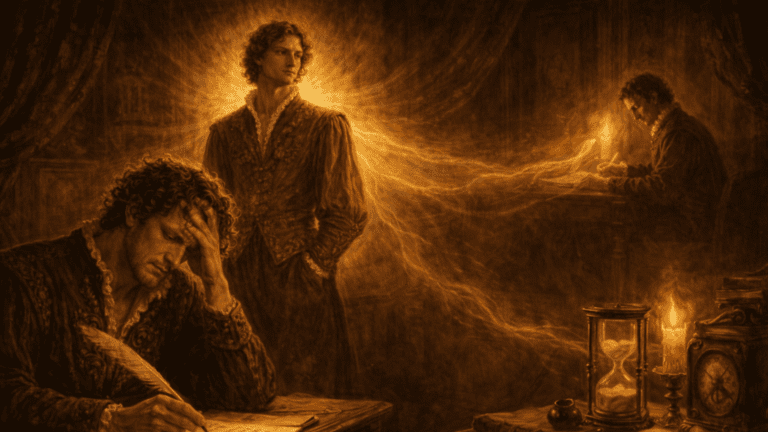
A Renaissance-style scene of a poet at a desk with a faint Muse behind him and a glowing portrait nearby, symbolizing inspiration, silence, and the preservation of beauty in Sonnet 101.

Sonnet 101: O Truant Muse What Shall Be Thy Amends

Summary and analysis of Shakespeare’s Sonnet 101: themes, imagery, and key lines.

A Renaissance-style scene of a struggling poet and a confident rival both inspired by a radiant nobleman, symbolizing creative insecurity in Sonnet 80.

Sonnet 80: O, How I Faint When I of You Do Write

Read Sonnet 80 by William Shakespeare with the full poem, meaning, themes, and a clear literary analysis.

A Renaissance-style scene of a quiet poet at a desk with minimal writing while another poet displays ornate pages, symbolizing silent devotion versus elaborate praise in Sonnet 85.

Sonnet 85: My Tongue-Tied Muse in Manners Holds Her Still

Read Sonnet 85 with full text and analysis exploring silent love, rival poets, and the power of thought over words.

A Renaissance-style scene of a naturally handsome young man contrasted with figures wearing wigs and cosmetics, symbolizing natural versus artificial beauty in Sonnet 68.

Sonnet 68: Thus Is His Cheek the Map of Days Outworn

Read Sonnet 68 with full text and analysis on natural beauty, artificial enhancement, and Shakespeare’s critique of imitation.

A Renaissance-style image of a handsome young nobleman in a garden while shadowy figures observe him, symbolizing the contrast between outward beauty and damaged reputation in Shakespeare’s Sonnet 69.

Sonnet 69: Those Parts of Thee That the World’s Eye Doth View

Read Sonnet 69 by William Shakespeare with full text and analysis of beauty and the tension between appearance and character.

A Renaissance-style scene of a nobleman admired by some while others whisper in shadow, symbolizing charm, criticism, and reputation in Sonnet 96.

Sonnet 96: Some Say Thy Fault Is Youth, Some Wantonness

Read Sonnet 96 by William Shakespeare with the full poem, meaning, themes, and a clear literary analysis.

A Renaissance-style scene of a nobleman overlooking ruins and eroding landscape, symbolizing time’s destructive power in Sonnet 64.

Sonnet 64: When I Have Seen by Time’s Fell Hand Defaced

Read Sonnet 64 by William Shakespeare with the full poem, themes, meaning, and a clear literary analysis.

Older posts
Newer posts
← Previous Page1 … Page3 Page4 Page5 … Page10 Next →
+ More

Looking for Something?

WShakespeare.com offers Shakespeare’s works, clear analyses, and guides designed to make his writing accessible to modern readers.

Recent Articles

  • Sonnet 58: That God Forbid, That Made Me First Your Slave
  • Sonnet 76: Why Is My Verse So Barren of New Pride
  • Sonnet 92: But Do Thy Worst to Steal Thyself Away
  • Sonnet 110: Alas, ’Tis True, I Have Gone Here and There
  • Sonnet 59: If There Be Nothing New, But That Which Is

Pages

© 2026 WShakespeare.com. All rights reserved.
Next Page »
  • Poems
  • Sonnets
  • Biography
  • Reference

Powered by
►
Necessary cookies enable essential site features like secure log-ins and consent preference adjustments. They do not store personal data.
None
►
Functional cookies support features like content sharing on social media, collecting feedback, and enabling third-party tools.
None
►
Analytical cookies track visitor interactions, providing insights on metrics like visitor count, bounce rate, and traffic sources.
None
►
Advertisement cookies deliver personalized ads based on your previous visits and analyze the effectiveness of ad campaigns.
None
►
Unclassified cookies are cookies that we are in the process of classifying, together with the providers of individual cookies.
None
Powered by