William Shakespeare is buried in the chancel of Holy Trinity Church in Stratford-upon-Avon, beneath a stone that does not carry his name. He was buried there on April 25, 1616, two days after his death, and the slab above him bears a four-line verse that ends with a curse on anyone who moves his bones.
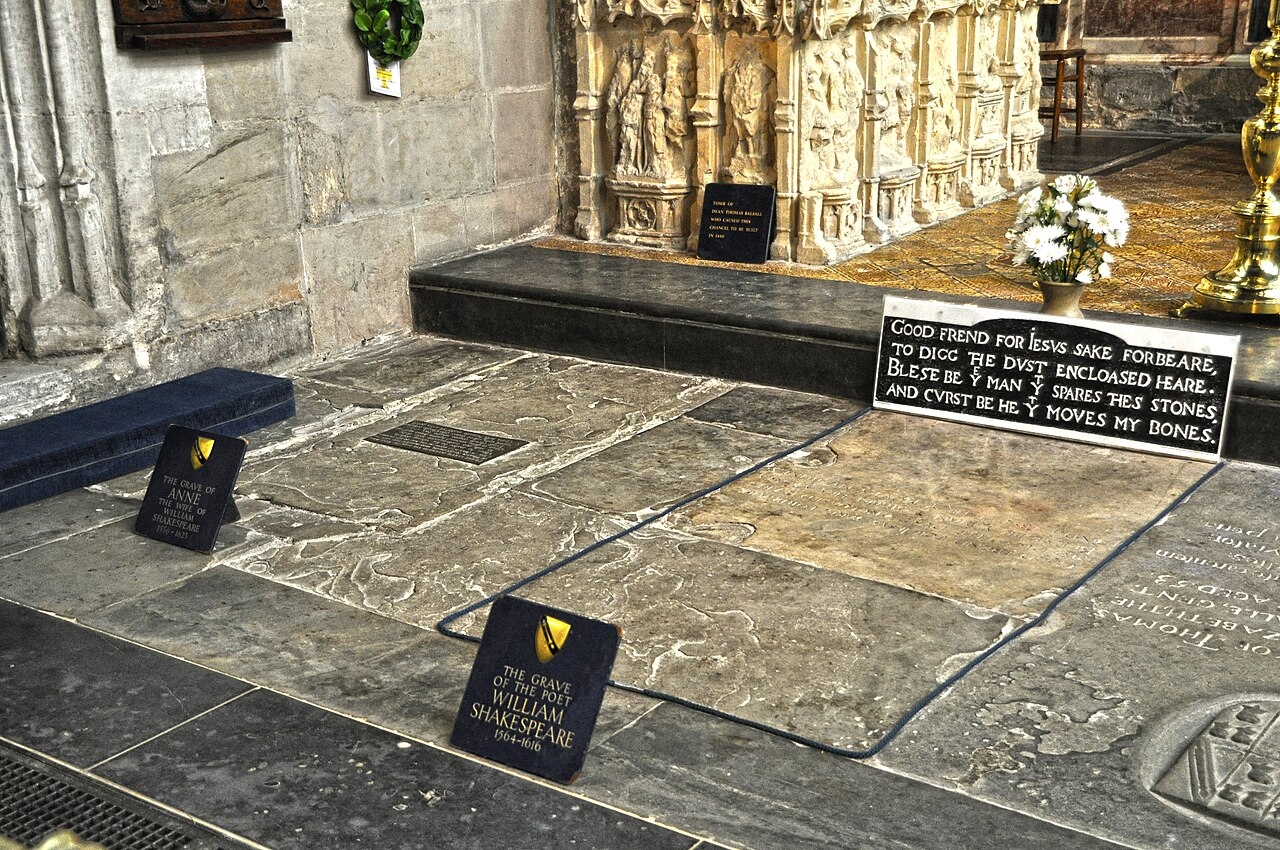
On the wall beside the grave is a painted monument, in place by 1623, with a half-length figure of the poet and a second epitaph in Latin and English. In the floor next to him lie his wife, his elder daughter, her husband, and the first husband of his granddaughter. This article sets out what the records show about the grave, what the epitaph says and whether Shakespeare wrote it, how the monument came to be, and what a radar survey of the grave found in 2016. For the months that led up to his death, see our article on Shakespeare’s later life and death.
At a Glance
Here are the key facts about Shakespeare’s grave and epitaph for quick reference.
Where Shakespeare Is Buried
Holy Trinity Church stands on the bank of the River Avon in Stratford-upon-Avon. Shakespeare was baptized there on April 26, 1564, and buried there fifty-two years later. His burial was entered in the parish register on April 25, 1616, as “Will Shakspere gent.,” the last word marking the status of gentleman that his family had held since his father was granted a coat of arms in 1596. The cause of his death is not recorded.
Most people in Stratford were buried in the churchyard. Shakespeare was buried inside the church, in the chancel, the eastern end that holds the altar, and he owed that place to a business deal rather than to his fame. On July 24, 1605, he paid £440, a very large sum, for a half-share in a lease of a portion of Stratford’s tithes, the church taxes on local produce. Holding the lease made him one of the church’s lay rectors, and lay rectors had the right to be buried in the chancel.
His grave lies in the chancel floor near the altar, a short distance from the north wall. The chancel was in poor repair when he was buried there and was restored in the early 1620s. The stone that covers the grave is a plain slab. It has no name, no dates, and no coat of arms, only four lines of verse.
What the Epitaph Says
The verse is cut into the stone in capital letters, with the old spellings and abbreviations of the period:
GOOD FREND FOR IESVS SAKE FORBEARE
TO DIGG THE DVST ENCLOASED HEARE
BLESTE BE YE MAN YT SPARES THES STONES
AND CVRST BE HE YT MOVES MY BONES
Several of the letters need decoding. The carver used V for U and I for J, as many inscriptions of the time did, so “IESVS” is “Jesus” and “DVST” is “dust.” “YE” and “YT” are abbreviations for “the” and “that,” in which the Y stands in for an old English letter, the thorn, that was pronounced “th.” In modern spelling, the epitaph reads:
Good friend, for Jesus’ sake forbear
To dig the dust enclosed here.
Blessed be the man that spares these stones,
And cursed be he that moves my bones.
The verse is two rhyming couplets in short, four-beat lines, much plainer than the five-beat iambic pentameter of the plays and sonnets. It speaks in the first person, as if from the grave, and it addresses the reader as a “friend.” The first couplet asks a favor in the name of Christ. The second sets a blessing against a curse, and the curse gets the last word. The “dust enclosed here” is the body itself, and the “stones” are the slab and the grave beneath it.
Why the Epitaph Warns Against Moving His Bones
The usual explanation for the curse stood a few paces from the grave. Holy Trinity had a charnel house, a building attached to the north side of the chancel where the sexton stored bones dug up from the churchyard to make room for new burials. It was in use in Shakespeare’s lifetime. The travel writer Samuel Ireland, writing in 1795, said it held the largest collection of human bones he had ever seen. The building was pulled down in 1800, and its basement was vaulted over with the bones still inside.
By tradition, the epitaph was aimed at the sexton, to keep Shakespeare’s remains out of that building. Later Stratford visitors were told as much. In 1693 a visitor named Dowdall was shown the grave by the parish clerk, a man said to be over eighty, who told him Shakespeare had written the verse a little before his death. The clerk added that his wife and daughters had wanted to be buried in the same grave, but no one dared to open it because of the curse. The next year, a visitor named William Hall explained the plainness of the verse by saying it had been written to frighten parish clerks and sextons, whom he dismissed as mostly ignorant men. Hall also claimed that Shakespeare had been buried seventeen feet deep, a claim the 2016 survey has since disproved.
The explanation has a weakness. As the Shakespeare Birthplace Trust points out, a lay rector entitled to burial in the chancel had little reason to expect his bones to be moved. If the verse was meant as protection, it may have been a guard against something that was unlikely to happen anyway, or a warning for a future no one could predict.
Did Shakespeare Write His Own Epitaph?
Nobody knows. The verse was identified with his grave very early, but it was not credited to him until decades after his death. The earliest known copy was made by the antiquary John Weever, who transcribed both the grave verse and the monument inscription in a manuscript that scholars date to somewhere between about 1617 and the mid-1620s. Weever does not say who wrote the lines. William Dugdale printed the epitaph in his Antiquities of Warwickshire in 1656, and he does not name an author either.
The first attributions appear in manuscript commonplace books, collections of verses copied out by their owners. One compiled around 1655 by Francis Fane ascribes the lines to Shakespeare, and one begun in 1669 by Henry Newcombe says they were placed on the grave by Shakespeare’s own arrangement. The Stratford reports of the 1690s repeat the claim. By then it was a local tradition, more than seventy years after the burial and too late for anyone to have remembered the funeral.
There is also evidence that the verse, or something close to it, was a stock formula. A ledger stone to a woman named Mary Jackson, who died in 1676, in the church at Allesley in Warwickshire, about seventeen miles from Stratford, carries a clumsier version of the same lines. It may simply copy Shakespeare’s stone, which Dugdale had made famous. The nineteenth-century scholar J. O. Halliwell-Phillipps also reported a similar “epitaph on a baker” from a manuscript of about 1630, but the later scholar E. K. Chambers could not trace his source.
One further complication concerns the stone itself. According to Halliwell-Phillipps, the slab had sunk and was replaced, probably in the eighteenth century. Some writers take this to mean the present stone is a copy, while others think the original was simply relaid. Either way, the words on the floor today match the earliest transcriptions closely. What remains open is whether Shakespeare wrote them, chose them, or had nothing to do with them. Many biographers accept the tradition that he wrote them. The case for it rests on tradition, not on documents.
The Funerary Monument
Set into the north wall of the chancel, above and beside the grave, is Shakespeare’s funerary monument. It shows the poet from the waist up, with a quill in one hand and a sheet of paper resting on a cushion under the other. The figure and cushion are carved from a single block of limestone. Above them are his coat of arms and two small seated figures: one, representing Labor, holds a spade, and the other, representing Rest, holds an upside-down torch and a skull.
The date it was put up is not known, but it was there by 1623. In that year, the First Folio of his plays included a poem by Leonard Digges that mentions “thy Stratford monument.” The monument has traditionally been credited to Gerard Johnson, a sculptor from a family workshop in Southwark, but the historian Lena Cowen Orlin has argued that it was more likely made by his brother Nicholas Johnson, and possibly commissioned by Shakespeare himself. Along with the engraving on the title page of the First Folio, it is one of two images generally accepted as showing what Shakespeare looked like. Critics have been hard on it. The scholar J. Dover Wilson said it made him look like a “self-satisfied pork butcher.”
Beneath the figure is a Latin couplet: “Iudicio Pylium, genio Socratem, arte Maronem, / Terra tegit, populus maeret, Olympus habet.” It compares him to Nestor, the wise king of Pylos, in judgment; to Socrates in genius; and to Virgil, whose family name was Maro, in art. The second line means, “The earth covers him, the people mourn him, Olympus has him.” Below that is a verse in English:
Stay, passenger, why goest thou by so fast?
Read, if thou canst, whom envious death hath placed
Within this monument: Shakespeare, with whom
Quick nature died, whose name doth deck this tomb
Far more than cost, sith all that he hath writ
Leaves living art but page to serve his wit.
A final line in abbreviated Latin gives the date of death: he died in 1616, in his 53rd year, on April 23. That line is the source for the date of his death, since the burial register records only the burial.
The monument has changed over four centuries. The earliest printed picture of it, an engraving in Dugdale’s 1656 book, shows no quill or paper and a cushion held against the body, a difference that doubters in the authorship debate have made much of. It was restored in 1748–49, paid for in part by a performance of Othello in Stratford in 1746. In 1793 the scholar Edmond Malone persuaded the vicar to have it painted white, to suit the taste of the day, and the original colors were recovered and repainted in 1861. The quill is a real one, and it has been stolen and replaced several times.
The Family Graves Beside Him
Shakespeare’s stone is one of a row of five across the chancel floor. Between his grave and the north wall lies his wife, Anne, who died on August 6, 1623, and was buried two days later. Her stone carries a brass plate giving her age as 67 and a Latin verse written in the voice of one of her children, praying that she will rise again. The Shakespeare Birthplace Trust suggests Susanna may have composed it. On his other side lie Thomas Nash, the first husband of his granddaughter Elizabeth, who died in 1647; John Hall, his son-in-law, who died in 1635; and his elder daughter, Susanna Hall, who died in 1649.
The family stones are grander than his, with coats of arms and full inscriptions, and Susanna’s epitaph praises her as “Witty above her sex” and says that “Something of Shakespeare” was in her. His younger daughter, Judith, who died in 1662, is not in the row. The Church Monuments Society has observed that the burials in the chancel follow the line that inherited Shakespeare’s property rather than the family as a whole. Our article on Shakespeare’s children and descendants sets out what became of each of them.
What the 2016 Radar Survey Found
For the 400th anniversary of Shakespeare’s death, Holy Trinity allowed the first archaeological investigation of the grave. The church would not permit digging, so the archaeologist Kevin Colls of Staffordshire University and the geophysicist Erica Utsi used ground-penetrating radar, which maps what lies under a floor without disturbing it. The results were broadcast in March 2016 in the Channel 4 documentary Secret History: Shakespeare’s Tomb.
The survey found that Shakespeare and his family were not buried together in a deep vault, as some had assumed, but in separate, shallow graves, each less than three feet deep. There were no traces of nails or other metal, which suggests the bodies were wrapped in shrouds rather than placed in coffins. At the head end of Shakespeare’s grave, the radar showed signs of an old disturbance and a later repair to the floor. Colls said it was “very, very convincing” to him that the skull was no longer in the grave.
That conclusion revived an old story. In 1879 the magazine The Argosy published an account, signed “A Warwickshire Man,” claiming that in 1794 a young doctor named Frank Chambers had hired three local men to break into the grave and steal the skull, hoping to sell it to the writer Horace Walpole. The author was later identified as the vicar of Beoley, a village about fifteen miles away, and a sequel claimed the skull had ended up in a crypt in his church. The Beoley skull was examined in 2016 and turned out to belong to a woman who had died in her seventies.
Not everyone accepts the theory. The vicar of Holy Trinity at the time, Patrick Taylor, said he was not convinced there was enough evidence to conclude the skull had been taken, and the church has no plans to open the grave. Michael Dobson of the Shakespeare Institute pointed out that the grave-robbing tale began as a short story. The Church Monuments Society suggests the disturbance could equally be the eighteenth-century repair of the sunken slab. The radar can show that something happened at the head of the grave, but not what.
A Closer Reading: The Stone That Asked for the Least
Three texts mark Shakespeare’s death, and each makes a different bargain with time. The monument on the wall names him and praises his mind, setting him beside Nestor, Socrates, and Virgil. Leonard Digges’s poem in the First Folio goes further and dismisses both stone and monument, telling Shakespeare that through his works his name will outlive “Thy tomb,” and that the book will keep him alive “when that stone is rent / And time dissolves thy Stratford monument.” The grave slab asks for far less than either. It does not name him, praise him, or mention that he wrote anything. It asks only that the body underneath be left where it is.
Four hundred years later, the smallest request is the one that has been most closely kept. The monument has been restored, whitewashed, repainted, and robbed of its quill. The charnel house the verse may have been written against was demolished. When workmen repairing vaults in the chancel in 1796 uncovered an opening in the ground near the grave, the clerk was called to guard it while they finished. Holy Trinity has turned down many requests over the years to excavate the grave, and when the radar survey was finally allowed, it was allowed on the condition that nothing be dug. Whether Shakespeare wrote the curse or not, the church has continued to obey it.
That obedience now has a curious result. The 2016 survey raised a question, whether the skull is still there, that only an excavation could settle, and an excavation is exactly what the verse forbids. The curse no longer protects just the bones. It protects the uncertainty about them.
Whoever wrote the lines, the playwright had already imagined what they guard against. In the graveyard scene of Hamlet, a gravedigger sings as he tosses old skulls out of a grave to make room for a new burial, and Hamlet, watching, asks, “Did these bones cost no more the breeding, but to play at loggets with ’em?” Loggets was a game of throwing sticks at a stake. The epitaph gives a plain answer to Hamlet’s question, addressed to the man with the spade: these bones stay.
Common Questions
The questions readers ask most often about Shakespeare’s grave and epitaph, answered briefly.
Where Is Shakespeare Buried?
In the chancel of Holy Trinity Church, Stratford-upon-Avon, the church where he was baptized. He was buried there on April 25, 1616, two days after his death.
What Does Shakespeare’s Epitaph Say?
In modern spelling: “Good friend, for Jesus’ sake forbear / To dig the dust enclosed here. / Blessed be the man that spares these stones, / And cursed be he that moves my bones.”
Did Shakespeare Write His Own Epitaph?
Possibly, but it cannot be proven. The earliest copies of the verse do not name an author, and it was first credited to Shakespeare about forty years after his death. Similar wording appears on at least one other Warwickshire gravestone.
Why Is Shakespeare’s Name Not on His Grave?
No record explains it. The early descriptions of the stone record the verse but no name. It is identified as his by its position below his monument and beside his wife’s grave, and by transcriptions going back to the decade after his death.
Is Shakespeare’s Skull Missing?
It may be. A 2016 radar survey found a disturbance at the head end of the grave, which the lead archaeologist believes means the skull was taken. Others think the disturbance may be an old repair, and the church does not plan to open the grave to find out.
Why Was Shakespeare Buried Inside the Church?
In 1605 he bought a half-share in a lease of Stratford’s tithes for £440. That made him a lay rector of Holy Trinity, with the right to be buried in the chancel.
The End of His Story
Three articles about his last years and the family buried beside him.
Image: Stratford-Upon-Avon: Holy Trinity Church, Shakespeare’s Grave by Lewis Clarke, 2014, via Geograph Britain and Ireland and Wikimedia Commons, licensed under CC BY-SA 2.0.